

In preparation for this trip, I read about the history of Lithuania, and I found that it is much more complex than I had originally understood. Following in the guidance of travel writer, Nicos Hadjicostis, I understand that to begin to answer the questions posed about my great grandparents’ decisions to emigrate, I must first delve into the history of their origins. I agree with Hadjicostis that one must put some energy into learning about a country you plan to visit in order to reap greater benefits from the journey. This “magnification” will allow me greater understanding and empathy with the story of the Jewish population in Lithuania, and all of Europe, really, though Lithuania’s history of invasions and occupations is complex, even for Eastern Europe, and I’m only just beginning to grasp the high stakes my ancestors were facing in the early 1900s. Through this study of history, I have come to understand that all Lithuanians have suffered the effects of the persistent political upheaval, not only the Jewish citizens.
One of my guidebooks, Experiencing Lithuania: An Unconventional Travel Guide, by Columbia J. Warren, employs an approach to travel much like Hadjicostis. His numerous chapters include history, geography, weather, language, food and drink, places to visit, and many photos. An attorney, and now research administrator at Cornell University, he takes a scholastic approach to his study of Lithuania that I appreciate and trust. His book has been an excellent guide to planning my first trip and beginning the process of fact-finding while there.
My other text for historical data about Jews in Lithuania, Vilnius: Traces of the Jerusalem of Lithuania, by Irina Guzenberg, has given me a wealth of historical photos that help me to imagine the Vilnius of my ancestors’ era. For example, my apartment on Vokieciu Street, located in a building from the 1600s, was certainly a place that my ancestors might have walked by in their lifetimes. A photo of my building from 1916, in this book, confirms that the building hasn’t changed much!
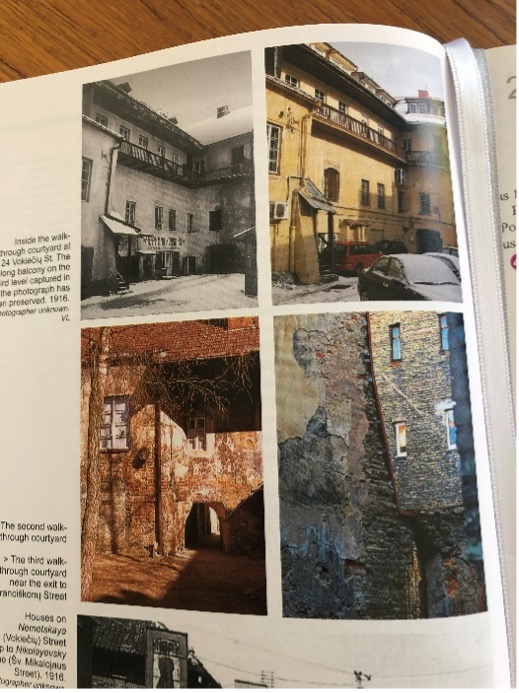
It gives me great joy to know that I am walking along the sidewalks they knew well. It binds me to this place and connects me in a soulful way that I hadn’t expected would be possible.
It is apparent that the history of Lithuania is marked by a pattern of historic upheavals and invasions, most of which were instigated by neighboring countries. These invaders include Russia and Germany, most frequently, but also Prussia, and even France, Poland, and Austria. From the 1400s, forward, Lithuania has bounced back and forth as an independent nation and an occupied one. According to Warren, Lithuania’s history is a “roller coaster of triumphs and tragedy,” (p. 10). During the 14-15th centuries, Lithuania was the largest and most expansive territory in Europe, forming what was known as the Great Duchy. Now, it is a small but thriving democracy, a NATO member, and a thriving economic and cultural entity of Europe and the world.
Though predominantly Roman Catholic today, this was not the case in the past, when Lithuanians resisted Christian indoctrination from the 10th-14th centuries. Preferring their pagan ways, Lithuania did not embrace Catholicism until 1386, when baptism was first allowed. And while Christianity does make headway in Lithuania, it continues to be a relatively open and diverse region, and it continues to include many pagan rituals and traditions to this day. Jews were tolerated and respected in the beginnings of their historical presence. It was only much later, in the 1800s, when Russia began its devastating attack on Jews, that their presence in Lithuania becomes more challenging. But it is important to note that there was a time when Jews and non-Jewish Lithuanians worked and lived in relative harmony. In fact, according to Warren, data suggests that the population of Vilnius in the 1800s and early 1900s, the capital city, was predominantly Jewish. It’s hard to fathom given that today, there is only one synagogue in the entire country (The Choral Synagogue, Vilnius, see photos below), and only a few thousand Jews currently live in the entire country of Lithuania.
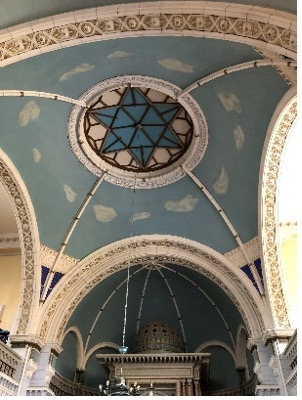
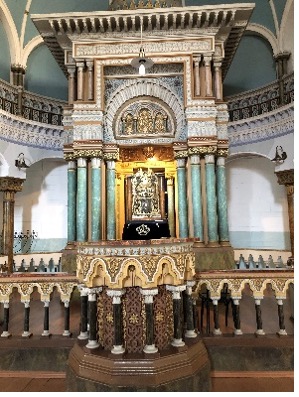
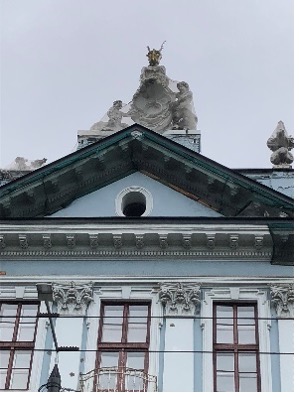
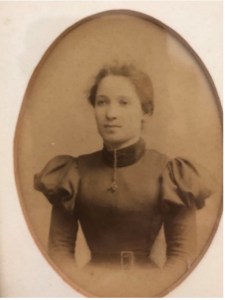
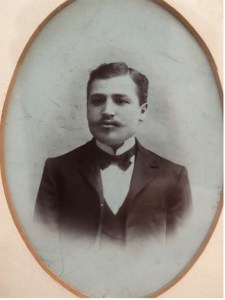
The general population today is considered predominantly white, and there is almost no diversity in the race in the country at all. The occasional black or brown person stands out and is most likely a tourist. At the suggestion of a Polish friend of mine, (in Los Angeles) I printed hand-sized photos of my great-grandparents to have in my pocket, should I meet anyone who might have some memory of our ancestors. After seven days here in Vilnius, and hours of walking in the streets each day, I’ve not seen one person that even remotely resembles my great grandparents, Dora and Joe.
Hadjicostis also talks about the ways in which one can really get to know the “soul of a country.” He suggests that these insights will come from many different avenues. The weather, geography, and topography, these details will have a great effect on how people carry on with their lives. Weather affects all our mindsets. Think about how gloomy we become in Los Angeles when we have a rainy week, or May-grey and June-gloom start all of our days with fog.
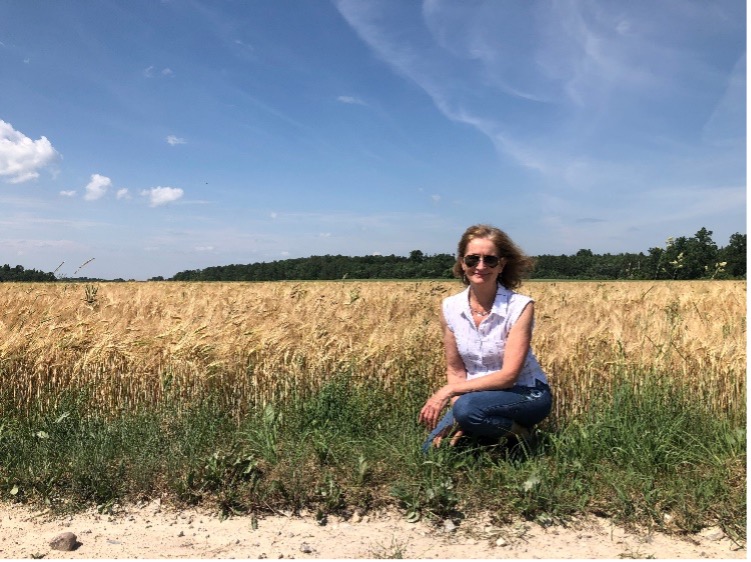
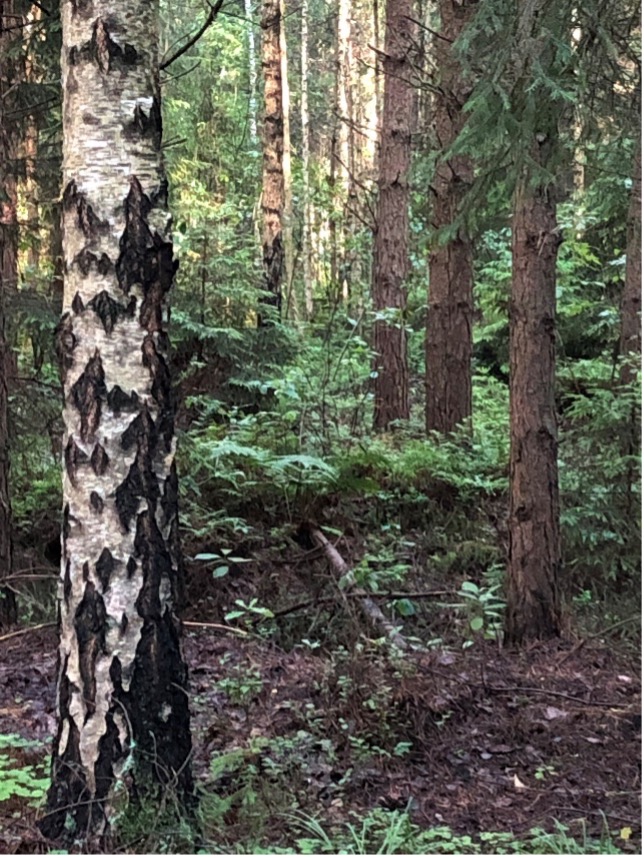
Lithuania, the name, means “land of rain.” The verdant countryside, fertile agricultural acreage, and dense birch and pine forests that stretch over a large part of the country are the pride and joy of Lithuanians, who put a high value on their vacation time in the country if they live in one of the cities. It is thanks to the copious amounts of rainy days that they have this incredible natural resource. But it’s cloudy, damp, and cold, much of the year. In Milwaukee, my ancestor’s new home, there are an average of only six sunny days in December. Ironically, the grey, damp, cold weather is something Lithuania and Wisconsin have in common!
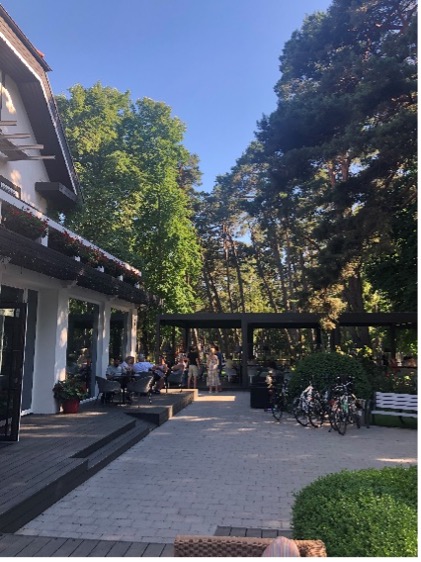
It is said that Lithuanians are a taciturn group, in general, preferring their solitude and own thoughts as opposed to engaging socially with people outside of their immediate circles. The gloomy weather may be to blame for some of that! The guidebooks warn that Lithuanians will not engage in eye contact with you in the street, and clerks in the stores will complete their duties for you but will not exchange smiles, small talk, or other typically socially oriented niceties. Today, as I write, it is my seventh day here, and while I normally make friends very quickly, it has taken most of this time to engage with people that I see in the café where I have my breakfast and the Iki grocery store where I purchase my groceries for my flat.
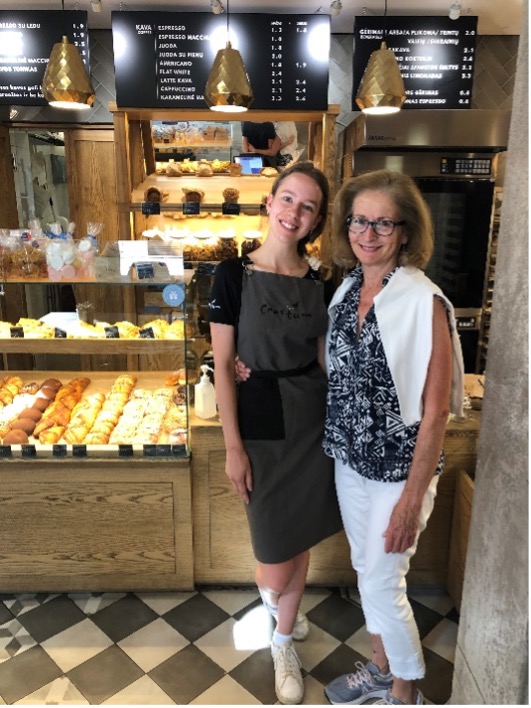
At the café, Crustum, I am now the recipient of welcoming smiles from the young woman who makes my morning cup of green tea (zalioji arbata) with steamed milk (karsto pieno). Gabija speaks English well and has taught me my first words in Lithuanian: labas rytas (good morning), and aciu (thank you). She is educated at the university level and is now taking Spanish language classes as well, knowing the value of speaking more than one idiom. She is efficient in the bakery, managing customers while also doing much of the baking. A gentle melodic tone alerts her to remove something from the oven! (see photos below).
I have also begun to converse on a daily basis with two men, Gediminas and Viktoras, who I would guess are in their middle sixties. They usually sit outside to drink a pair of lattes before starting their daily routines. Like with my former university coffee-klatch in Raleigh, these men are talkative and friendly, and now that I’ve cleared their initial period of aloofness, they are giving me insight into Lithuania’s personality and modern pulse. These are the kinds of genuine impressions that you can’t find in a guidebook. They only come from interactions with locals.

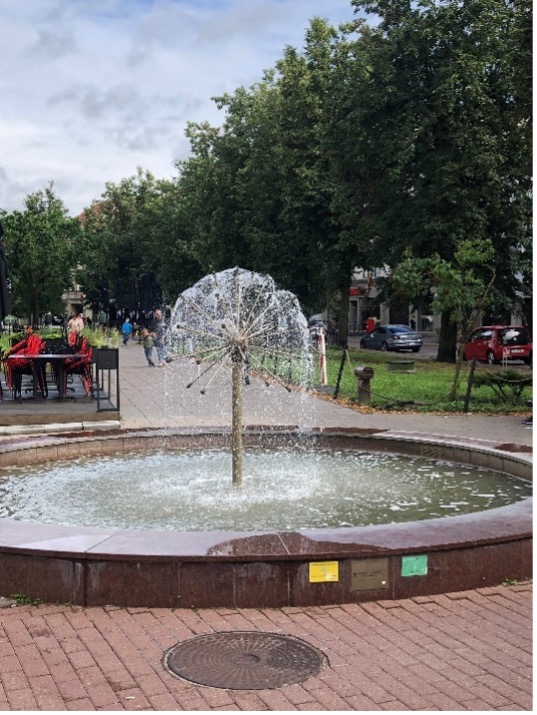
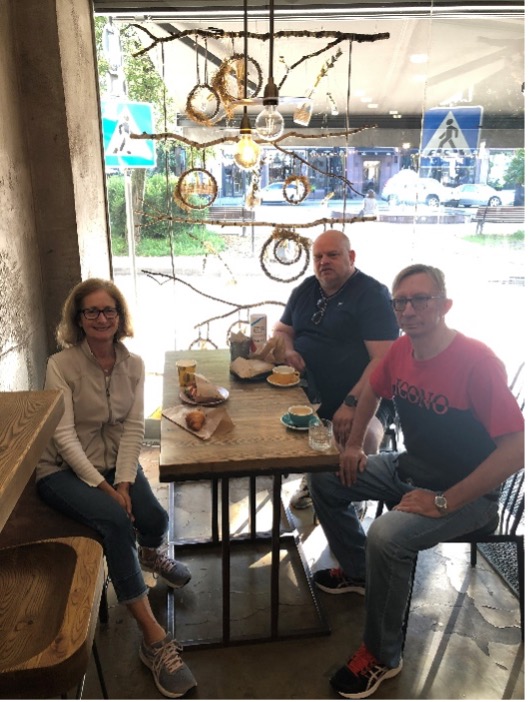
Of the two men, Gediminas is the more proficient English language speaker, and he has traveled to the U.S., visiting New York, Miami, and Chicago. He is clearly educated, and he seems to know a lot about the history of Lithuania, confirming many details that I’ve read in my preparation for visiting this country. He is also quite humorous, giving me some insight into the ironic or sarcastic side of Lithuanian life and viewpoints. For example: Where is it you have not yet been? A cheeky reference to the fact that many Lithuanians have had to escape from the country due to cyclical political upheavals, invasions, and occupations by Russia and Germany, and other invaders. As he was laughing about the fact, that many people from Lithuania have considered moving away, at one time or another, I was thinking of my family, who fled to avoid conscription into the Russian army.
My Nana’s parents and her and brothers and sisters, all emigrated to Milwaukee, Wisconsin, between 1906-1908. I have discovered that others, more distantly related, such as spouses of their cousins, came a few years earlier, paving the way for this familial emigration. While I have yet to contact directly these relatives of mine, I’ve come to know of their existence through Ancestry. I’ve also been able to view an occasional photograph posted to their family trees.
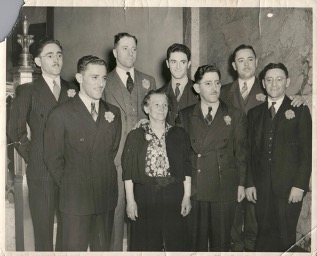
I was very moved by the photo of my great-grandmother’s sister, Anna Druskin, who gave birth to seven sons (two in Lithuania, and five in the United States). How proudly she stands at the center of this handsome group. It is likely that none of these men would have made it to young adulthood if they had remained in Lithuania.
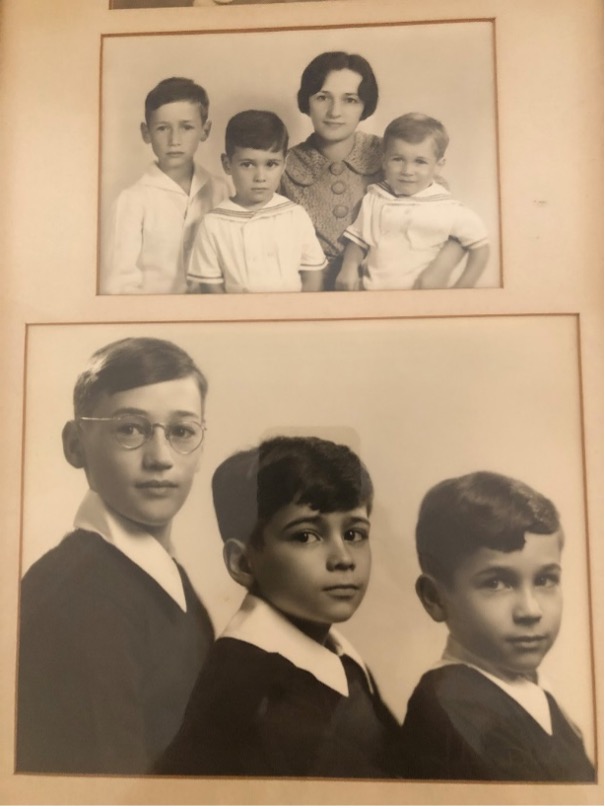
While I have never met any of these ancestors, I see a resemblance between some of them and my family, especially my father’s two younger brothers, Uncle Phil (1934-1996), and my Uncle Tom (1932-) with whom we are about to celebrate the 90th birthday in Highland Park, north of Chicago. I have learned that this suburb of Chicago has a large and vibrant Lithuanian population, and it is where, in my childhood, we traveled by train from Milwaukee to visit Nana’s aunts, Libbie and possibly Anna, the woman in the photo. Here is a photo of my father, the oldest, with his two brothers and mother. My grandmother, at the age of about 30 years old, is the niece of Anna Druskin. The resemblance is striking. This is the reason I’ve come to Lithuania; to see and feel these connections of the family to the land, to the place where it all began.
Hadjicostis emphasized geography and weather as a way to understand more fully the soul of the place. In the case of Lithuania, weather and geography have played a large role in defining who it is as a nation; how its people celebrate on a yearly basis. Perhaps it is also why my great grandparents chose to emigrate to Wisconsin. I don’t believe the selection of Milwaukee as their destination was merely a coincidence.

First of all, Lithuania’s location at the 46th parallel, is as far north as Newfoundland, in Canada. Its extreme northern location guarantees long, dark, cold winters, and in contrast, beautiful long days in the summer. As a result, Lithuanians choose to spend as much time outside, in the light, in both the summer and the winter, almost worshipping the sun’s presence and health effects on both their physical and mental wellbeing.
While Milwaukee is not located nearly as far north as Vilnius, it shares both topography and weather patterns with Lithuania, as both areas were greatly affected by the passing of glaciers and they are located next to a large body of water, Lake Michigan (might as well be a sea), and the Baltic Sea. Wisconsin and Lithuania are dotted with hundreds of freshwater lakes, cool streams, marshy bogs, fertile open lands, and thick forests. The weather patterns are quite similar, with long dark, very cold winters, and though summers are seemingly short, the days are long, and successful agriculture is possible and profitable.
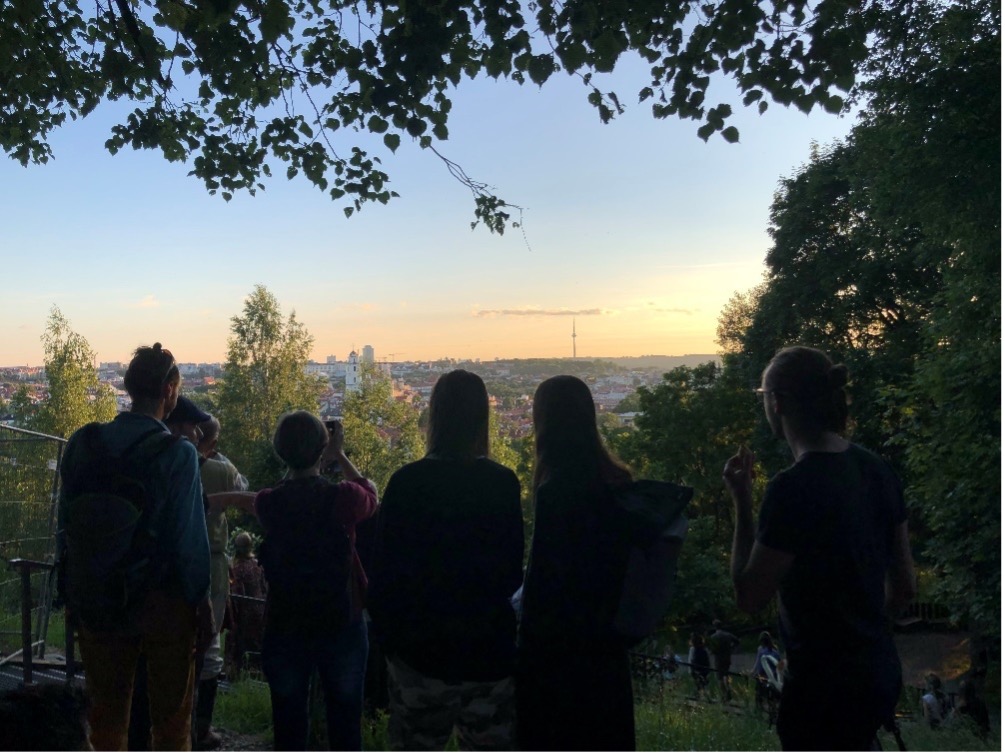
I am visiting Vilnius during the summer solstice, or “mid-summer,” as Lithuanians call it, and the long summer days are remarkable. The sun sets around 10 p.m., but because of the gentle slope of the sun’s angle at this northern latitude, the sky remains bright almost until midnight. The sun makes its reappearance after just a few hours, with the sky beginning to brighten around 3 a.m., and full sunrise occurring just past 4:30. In northern Wisconsin, the sun sets around 9:30 p.m. and rises by 5:00 a.m. Wisconsinites take full advantage of the summer months, spending as much time as possible outside, on the lakes and rivers, fishing, boating, and enjoying nature. There are numerous outdoor festivals and concerts and theater. People also participate actively in winter activities in both regions. From my short time in Lithuania, so far, it seems that these two locations have a lot in common.
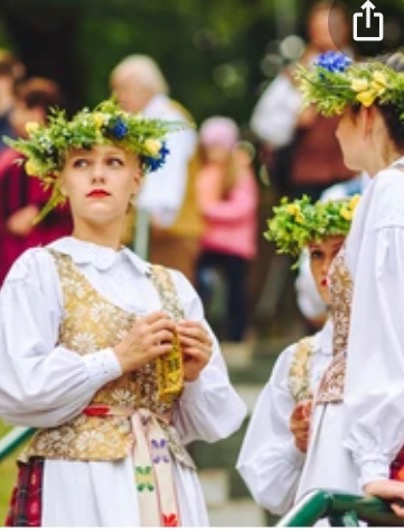
Each night of this past week, there have been festivals of music and dance in the parks and on the hillsides around Vilnius. Many of the women and men dress in costume and/or wear rings of woven greenery and flowers in their hair. The women wear loose-fitting linen dresses, shifts, with flowers in their hair and around their necks, and the few men in costume wear what I would call linen britches, that clasp around the leg, just below the knee. The children dressed in modern-day t-shirts, shorts, and tennis shoes, also sport flower rings on their heads, and I see them also in the morning, traipsing with their mothers or fathers, apparently off to camp or other school activities, carrying a backpack and a ring of flowers in their hands for the day.
The songs they chant at night in these large gatherings are repetitive rounds, sung acapella or with simple flutes and harmoniums, in three-part harmony. I say harmony, but it’s really not all that harmonious, as they intentionally sing the three parts in slightly dissonant chords, meant to tangle with each other before the sounds are merged at the end, back in harmony. It’s almost as if you can feel life’s challenges through the tension produced by these mildly dissonant notes. The songs are haunting and reminiscent of their pagan roots, and they are often sung by hundreds of people gathered spontaneously on a hilltop at sunset. Quite an unforgettable experience!
In conclusion, if I’ve learned anything from these first ten days in Lithuania, it’s that all people are complex mixtures of past and present, geography and weather, and just plain old genetic serendipity. If I arrived with any preconceived notions about Lithuanians, mostly they’ve been tweaked already by the reality I see on the streets. The various tour guides who have led the many tours I’ve taken since arriving have all been sincere about the complex historical and political past of Lithuania. They seem anxious to confront the negative and positive sides of their language, culture, and history, and they express a desire for a solid and consistent future that includes diversity, inclusivity, and peace. I will meet with the archivist who is helping me trace my family’s roots tomorrow. I am glad that it has taken a full week and more for us to finally get together (due to Covid, what else?) because it has given me a chance to get to know Lithuania first.
Capsule #1: The Canine icebreakers (added photos follow capsule)
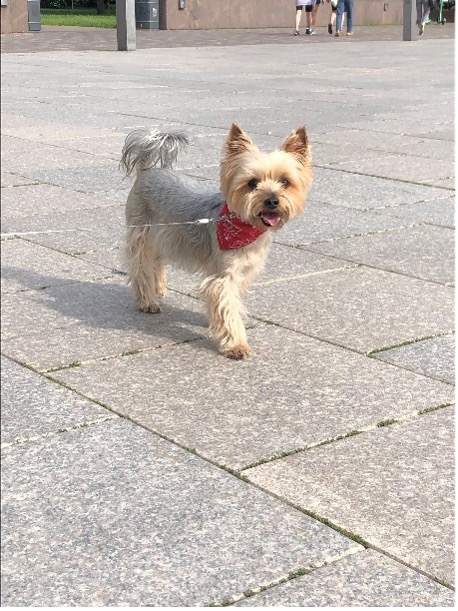
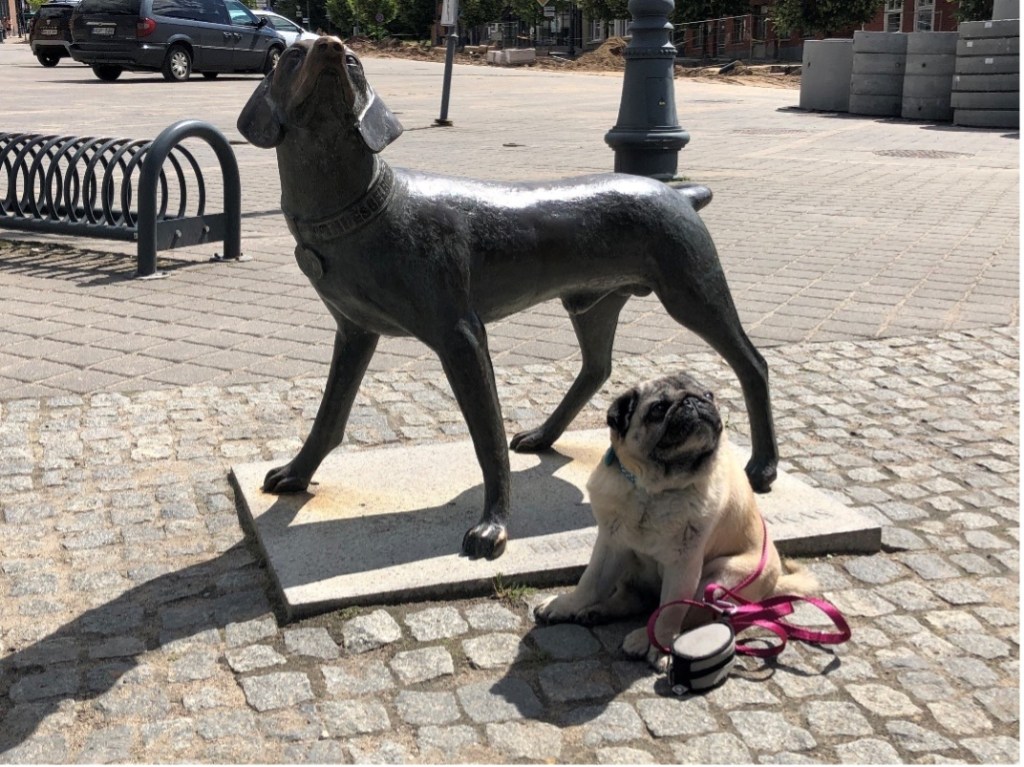
You don’t have to be in Vilnius long to see that Lithuanians love their dogs. People are walking with their pets on every street. You see many different breeds, from large to small, though the majority seem to be in the small to medium size. I’ve seen Labradors, (white is the favorite color), poodles, many kinds of small, fluffy boutique dogs, also French Bulldogs, and even a Basenji. There is also the Lithuanian Hound, the only dog originating in Lithuania. He dates from medieval times, as far back as the period known as the Grand Duchy. It has impressive eyesight and is adept at hunting hare, fox, and wild boar. It is a medium-sized dog, usually a black and brown mix, with a Labrador-like face, and fur like a Beagle. They have a sweet face, and long, active tail, that is not bushy.
The dogs I’ve seen on the street are well-mannered, accustomed to an urban environment, and, for the most part, friendly and well-acclimated to engaging with other dogs and strangers. Most shops and restaurants are dog-friendly. The animals go in and out of places without any issues. A handful of the dogs are off-leash and very well mannered, but the majority are on a leash, comfortable navigating cobblestone streets, irregular sidewalks, ancient curbs, cars and scooters, pedestrians, and admiring tourists.
Lithuanians may be on the shy side and less inclined toward engaging with strangers, especially on the street, but if you smile at their dog, it’s a different story. I have not hesitated to smile and point at people’s adorable pets as they stream by me on the sidewalk, and their owners often stop, allow me to pet their dog, and engage in conversation. And of course, the remarkable thing is that most Lithuanians know enough English to speak at a basic level, so a mutually appreciative conversation about their dog is entirely possible.
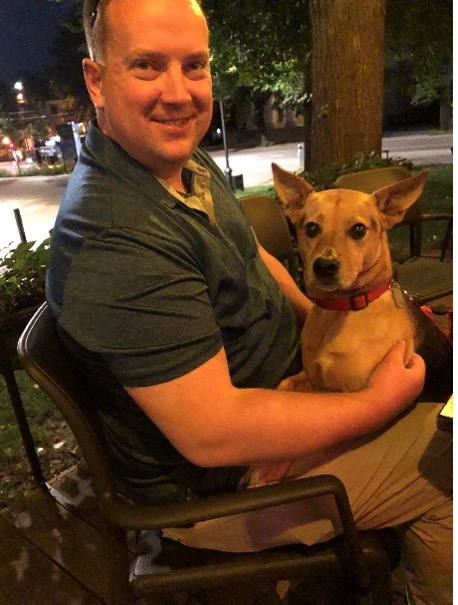
I’ve met several people who now routinely engage with me outside on the street or at the café thanks to our initial conversation about their dog. For example, my café friends, Gediminas and Viktoras, first spoke with me when I asked about their French Bull Dog. We now share tea and coffee every morning at the Crustum Café. I’ve learned so much about Lithuania from them, both historical information and things about their daily lives; the details tell me who Lithuanians really are. It gives me a sense of the soul of the country, or at least of Vilnius.
A woman and her daughter entered the café today with their dog, a curly-haired dachshund. His fur was clipped for the summer, giving him a shorter “do,” but leaving his burly eyebrows in place. He reminded me of Winston Churchill, with bushy white eyebrows! After we had a moment of petting the dog and an exchange of the details that dog lovers share, Gediminas winked at me and said, “his haircut costs more than a man’s haircut.” In other words, like Americans, Lithuanians are inclined to indulge their pets irrespective of costs.

Capsule #2: Idiomatic Phrases:
Nothing tells you more about the soul of a country than the idiomatic phrases that pepper a local person’s quotidian conversations. These phrases give us clues to a country’s history and personality. After only ten days here, I have begun my collection of idiomatic phrases. Here is a couple.
- If a child is not eating properly, the parent in charge tells him/her that if they do not finish their meals, they will receive a witch in their porridge! This derives from the many folk tales that are still told to children in Lithuania.
- Lithuania has always been an agricultural country, so many of its idiomatic phrases are oriented toward land and agricultural activities. For example, if someone is behaving arrogantly as if he or she has ‘really’ made it in the world, they will say, “Careful, you are only the third generation from the plow!” Another idiomatic phrase Lithuanians might say to a similarly haughty person is, “I can see the scythe in your pocket!”
- In another reference to country life, a person may say of himself when he’s feeling lazy, “I like to buy the tools, but I don’t like to use them.”
- During the Soviet occupation of Lithuania (ending with Lithuanian Independence in 1991), people lived with tremendous shortages of food, equipment, housing, and cars. You name it, they didn’t have it! One food that was terribly missed by all was bananas. Occasionally, word would spread that a shipment of bananas had arrived, and people would stand in line for hours to buy some for their families. The prices were ridiculously high, but because people craved a banana, they would pay anything to have them. So, when a person is asking for too much, for example, a teenager who wants clothes, shoes, a handbag, and hairbows, an exasperated parent or grandparent might sigh and say, “What else will she want, bananas?
All these phrases express appropriate feelings in a humorous way, and they also give us insight into the history of Lithuania, a country deeply connected to the land and one that has lived through much political upheaval and uncertainty with patience and humor intact.
 lalcsmsmu
Leave a reply to Marina Castillo, “Peru Held the Key” – LALCS Cancel reply