

Learning About Racism in a Taxi
When I was 12, my parents sent me to the Dominican Republic, and that was when I came to find out that my family was wrong, that I was, in fact, simply a black young man. That was the year of 1982 when I arrived at Santiago de los Caballeros accompanied by my father with a one-year student visa to learn Spanish and to learn more about the history, culture, and my family’s past, while exploring the land. While traveling from the airport to my family’s house, I remember how confused I was being a first-generation United States citizen with Dominican descent, as I noticed that that not all the natives were disconnected from their blackness. In fact, the black cab driver immediately explained me and my father the presence of a complex hierarchy in the Dominica Republic, which was based on the color of the skin, and why racial divisions will continue to exist in his country. Then the cab driver asked me if I was black of African American descent, and added that, “as Dominicans do not want to be involved with black people, we have been taught to dislike and to do not accept blackness.” I did not know what to say, as he continued saying that the root of those believes are found in history, as the Dominican Republic is the only country in Latin America that got its freedom, not from Spain but from Haiti, a black country.
Racism in the Dominican Republic Has its Own History
That day in the taxy I learned that Haiti obtained independence from France in 1804. and taken over the entire island of the Hispaniola, as it was known then. That was how for 35 years Dominicans were under the rule of the Haitians, the blacks, but only until 1838, when the Trinitarians founded the Dominican Republic. And for many years after that, even after Dominicans were freed on February 27, 1844, every single president instigated a sense of hate toward Haitians, the true blacks, the bad blacks, a believe passed on from one generation to another. That could be seen when in 1990, 1994, and 1996 Peña Gomez, a dark-skinned Dominican, was a presidential candidate. He encountered racism from the media, public officials, and from other candidates who referred to him as “a black Haitian that could never win a Dominican election,” and he did not. Crowds of opposing citizens opposed his campaign just because of his blackness, not taking in mind his capabilities to lead the country out of its current social-economic issues. That was how the people, media, and the country in general took on the streets and celebrated the loss of a black man who wanted to be the president of the republic, “son veinte pesos, said the taxi driver extending his hand as we arrived at our family’s home in Ensanche Libertad neighborhood.
Too Oscuro to Have a Dominican Girlfriend
As I started school, I began to interact with kids, mostly girls, who looked like me: dark-skinned. I heard them saying they were not like black people, but I did not pay attention. I was 12 years old and very much attracted to this Dominican girl, Belkis. I think she liked me as well, but at certain point she told me that her parents would not accept me. I did not understand. One day after school, I approached her as we were walking home and her father, who was even darker than me, immediately stated to her, “tu vas a dañar la Raza con este prieto feo; él es muy oscuro.” “He is too dark and would mess up our race,” her father said. That was perhaps the first time I felt as an outsider. He specifically indicated that it did not matter I was an American citizen, I was too black for his daughter, although she had the same skin color as mine. He did not accept me into his house. His daughter was only allowed to be my classmate during school hours.
La Niña, La Pinta, y La Santa Maria
I have to mention how I struggled speaking Spanish during my journey but thanks to my cousin Robert, I was able to learn as he took the time to guide me with a few vocabulary words. This helped me navigate with my three uncles, Pedro, Juan, and Domingo. Robert and my uncles all worked in the family butcher shop. I began to spend time with them and communicate the few words I had learned with my cousin Robert. They all spoke Spanish and identified themselves with Spain, with Españoles, with el Español Castellano. Pedro, the youngest, would explain with this pride how Cristobal Colon came with three boasts; La Niña, La Pinta y La Santa Maria, and taught the native Indians to speak Spanish, and to build the University of the Americas, Santo Tomas de Aquino, in 1518. However, Juan would remind his brother how Cristobal raped the natives and began separating the darker ones from the lighter ones to bring some of them back home to the queen Isabella. And yes, Juan added that the island did benefit from learning the language, but these ships came with infectious decease that wiped out all the indigenous people. Domingo added that we are not from Spain, that we are Mulatos, a mix of white and African, a truth we deny.
Our conversation got deeper, as I watched them slaughter the animals in preparation for the butcher shop. Robert would remind me that I was not American because I am black. “It does not matter if you were born in America, here, or there, you are less than the white man. In fact, there are resorts, night clubs and institutions in the Dominican Republic where you cannot enter.” Pedro added, “it does not matter how much money you have, or if you are an American citizen, you are not allowed in because you are black.” And Juan concluded saying, “I know you want to learn and understand why in this country we are not considered black, but it is not our fault, it is just how it is.” I wanted to reply as best as I could with my minimal Spanish, that “I am black with Dominican descent. In America, I am considered a Latino with African descent. Someone who can speak two languages, with brown skin and black hair. We are not thought to dislike black people because man originated from Africa, and all humankind has Afro-centricity in their genes.” But I remained silent. My family would laugh at me and tell my father this “Yankee must go home.” I felt as the Other in my family’s country of origin.
The Other-Bell Hooks
It was not until recently that I had the fortune to read Bell Hooks´ essays that I became aware of how Otherness is more complex idea and practice than I imagined. Uncle Juan was right, historically, the white man has violated the bodies of black women/women of color to assert their position as colonizer/ conqueror. In the present, these young men do not see themselves as racists who want to transgress racial boundaries within the sexual realm to dominate the Other. On the contrary, many of them believe their desire for contact with the Other represents a progressive change within white attitudes towards non-whites. I think differently. While in school in the Dominican Republic I needed to connect with a Dominican girl, someone who could understand and with whom I could share my Dominican pride, but I faced the barrier of racism within racism.
Writing this chronicle triggered hidden thoughts and gaps in my mind. In America, my family surrounded me and my siblings with a lie, a vicious upbringing centered in cultural views and practices of race in the Caribbean. But I did not allow anyone to dictate who I am. I am a black Latino, I am an African Caribbean American, also known as a Dominican, and a member of humanity.
Here some pictures of my dad and me, when he dropped me off and when he picked me up one year later.

When I first arrived with my American swag, Lee jeans, Puma sneakers thick two-color shoelaces and Le Tigre shirt 1980’s look.

After one year of being in the Dominican Republic my swag changed to slack pants, dress shirt and slip-on moccasins.
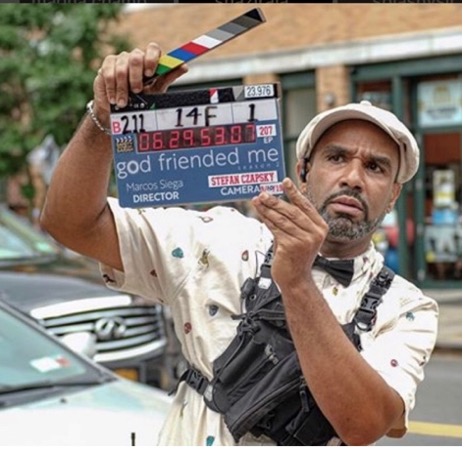
Angel R. Vasquez born in Harlem and was raised in Washington Heights, New York. He was blessed with rich resources to fuel his creativity including music, food, culture, and real-world realities from a young age. In his film career, Angel has been labeled “the Urban Journalist.” His first project “Never Again” was a video regarding being anti-drugs. He also wrote and directed other films including “Chronic Faces”, “El Entrago”, and has produced and directed several music videos including “Verbal Slugz” and “Check Da Demo”. Angel is currently the Camera Assistant Loader on the crew of NBC’s, God Friended Me Season 2. Prior to this show, he worked on other network shows including, HBO’s High Maintenance, CBS’, Madame Secretary and Spike Lee’s Netflix series, She’s Gotta Have It. Additionally, he has worked in Location Management on I am Legend, The Braver One, Spider-Man 3, Pride and Glory, and Get Rich or Die Tryin’. He continues to be a forever evolving artist and human taking in each experience, getting the most out of it, and sharing what he learns with the word.
A full list of Angel’s work and his director’s reel can be seen at:


 lalcsmsmu
Leave a reply to Carlos Cancel reply