

The first couple of days of the trip called for major adjustments. For as long as I can remember, I talked about leaving home and setting off on my own adventures, but as I grew older, I became more reserved and less daring. I stepped out of that plane from Los Angeles into the humid Lima air and still felt uneasy about the trip, even after the eight and a half hours I was sitting on a plane. Luckily, there was no time to dwell on it because it was a race through numerous checkpoints to connect with our domestic flight to Cusco. There were a few moments where anxiety almost doubled over but I held it in and knew this trip would test me more than once. By the time we arrived in Cusco, I had gotten a handle on my anxieties because my first apprehension had been faced: altitude sickness.
The Incan city is settled in the Andes at 11,152 feet in elevation. That meant my body would be getting less oxygen and could cause altitude sickness. If there is anything that gives me more anxiety, it’s the possibility of me feeling sick and it spirals into my time in Peru being miserable. But I was able to breathe normally within thirty-six hours of being a little disoriented by the change. This allowed me to settle and begin to release the tension from my shoulders.
Cusco was alive with music on our first night. We had decided that a brisk walk to the Plaza de Armas would do us good after a long night of travel. The streets were alive with music and dancing. A parade echoed off the cobblestone steps, all in lieu of the winter solstice celebration.

What struck me about Peru and its people was how connected they were to their Incan heritage, with the city of Cusco at the center of all. The horrendous history of the Spanish conquest is not absent in the main plaza. Incan temples were destroyed to serve as the foundation of the Spaniards’ catholic cathedrals. But the ninth Incan Emperor, Pachakutiq, stands proud at the center of the square. Dancing accompanied by strong drums and pan flutes, colorful costumes, and the waving of Cusco’s rainbow flag, are all symbols and proof that their Incan heritage could never be snuffed out.
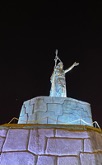
Inti Raymi is the Incan celebration and devotion to their sun god, Inti. The actual celebrations weren’t scheduled until the end of the trip but, like tourists, natives from all around Peru come to Cusco to join in the festivity weeks in advance. I latched onto the infectiousness. I had never seen or felt anything like it – a complete awareness of the evil but triumph in preservation. It was enough to get me out of my room every day, away from my reservations and fears, away from what was comfortable. We were on a schedule of different excursions and free days. The days when tours were planned always made adjusting easier. We spent a day in the Sacred Valley and visited ruins in Pisaq and Ollantaytambo. Walking around ruins is a funny business. The tail is steep so you’re tired and out of breath, but at the same time, there is a connection forming between you and the history of the places you are stepping in.
Capsule 1: The Fortress
By this stage in the climb, my knees felt like they were in my chest with the height of each step we took. Just watch your footing, one after the other, was on repeat in my head as a method of keeping myself upright. People really scaled this every day. The inconsistent levels of each step made the hike more disorienting, but eventually, the stairs stopped coming and we were standing at the top of Ollantaytambo, an Incan fortress. My guide muttered something about architecture and chiseled stone; I did my best to listen over my heart pounding in my ears. As we made our descent, we came across a long hallway at the top of the fortress, almost like a battlement. I slowed my pace and came to a stop at a small window overlooking the edge. Tourists dissolved from sight and the entire face of the fortress is seeping with shadow. I looked up to see the moon racing to block out the sun and I was swallowed in the dark of night. A soldier came running down the pass and stationed himself beside me. His young face was weary, and his tunic didn´t quite fit him right, hanging just above the ankles. The same went for the band he had tied around his forehead with the bright blues and reds of his station; he did his best to hide his adjustments to it. He’s too young to be defending this wall all on his own, too young to be defending this fortress, but he stood there with his shoulders and eyes set on whatever lurked below. Should death come, he would meet it with his spear first, no matter how much he trembled.
Lightning struck, immediately soaking us in a vicious storm, and with every flash of light, a battle raged. The boy took up a bow and fired arrows through the thin window, quickly getting out of sight with each release. Light flashes again and he was sprinting for his life as a boulder crashed into the side of the terraces. The stone buckled but didn´t crumble under the violent shakes of the structure. He, huddled into himself uncurled at the presence of a man who wore a headdress of shining gold and vibrant feathers and a mean look to him, a true battle-hardened. The man reached out a hand for the boy, pulling him to his feet and offering a bow with the other. The boy took it with newfound courage. The man in the headdress rushed off as the boy continued to nock his bow and let the arrows fly.
The sun won the battle with the moon and beamed on me once more with full force. The hiking group pushed me forward through the battlement and away from the window overlooking the structure. The boy was gone, and I was left wondering.
My advisor asked me which part of the trip was my favorite and, while each event, trail, and museum were filled with color, light, and culture, none compared to Machu Picchu. It was the last place on our list before returning to Cusco for Inti Raymi. By this time, I was settled. My nerves had calmed, and I had fully invested in making this trip as memorable as possible. I was committed to absorbing all I could from this travel. The ruins of the lost city opened a wall inside me. Up until this point, there was a ton of apprehension about my writing. I was hesitant for plenty of personal fears that were evidently holding me back. I believe all creatives go through the beginning stages where they are concerned with making the wrong decision and they carefully monitor what they put onto the canvas or page, or what have you. But eventually, the time comes for the wall to be broken down so that creativity can begin to flourish. That wall is different for everyone and so is the sledgehammer that crumbles it.
Creativity flows in all Cusco places, but it definitely lives in Machu Pichu. As I walked through one of its hallways and down more stairs to reach the bottom, my mind whirled with “what ifs” for scenarios and characters. My characters. Fantasy worlds that have lived in my mind were now coming to the surface because I had finally seen structures that matched places my characters could exist in. I don’t pretend to think that anyone outside of the Incas could have stood up on those battlements, but the complex architecture of the fortress, and the empty spaces, and rooms there could have been, lent so much to the imagination. Hiking quickly became my favorite part of the trip. Walking around those ruins, learning who may have lived there and what they may have done, opened my mind to visualize those people and to ask more about them.
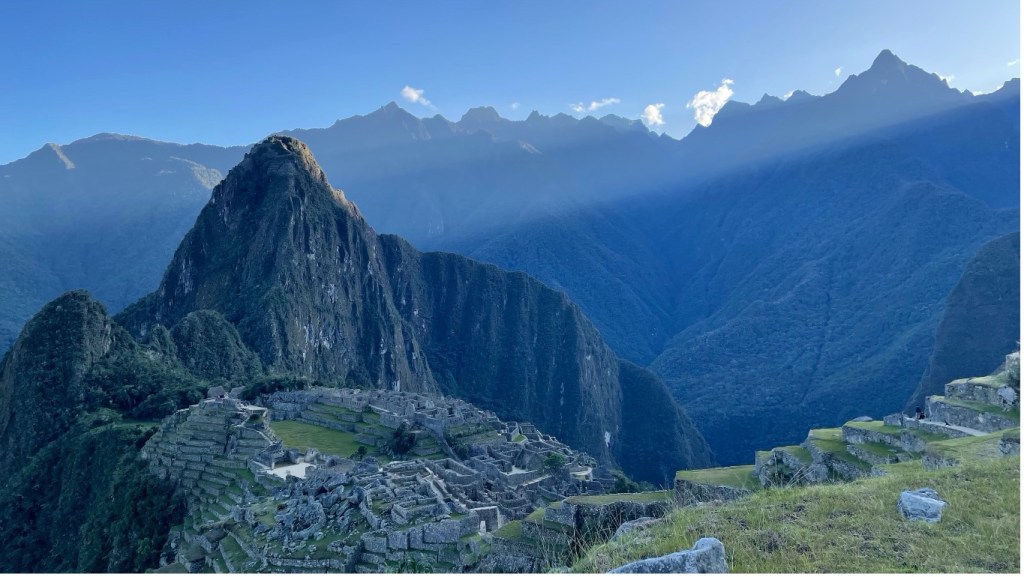
For me, the sledgehammer was Machu Picchu. The sun that rises over the eastern mountain was designed by the Incas. They made it so that the sun rays of every new morning would shine on Huayna Picchu to the south, casting almost a halo on the sacred place. Our guide walked us through what was the best-guided tour of my life, full of information about the nobles and royalty who might have lived there, and those who traveled up the mountain to work every day. The entire landscape was bright and colorful as if someone had cleaned the lenses of fingerprints and smudges. After being in Machu Picchu, I proudly share my philosophy of travel: Exploring the wonders our world offers will unlock the wonders within yourself.
Capsule 2: Maravilla del Mundo
To the Inca, three numbers are sacred: Two, Three, and Four.
The air seems cooler up here. People buzz around us, trying to get their pictures. I already got mine, which is the only reason why my camera and phone are stored away.
Two is for duality. The moon and the sun. Light and dark.
It’s quiet up here even though there are numerous tours already in progress this early. Everyone wants to watch the sunrise shine over the face of the Inca. And when the sun finally peaks through, we are all taken by surprise. The ticket said sunrise tour, but no one said anything about magic. Because that’s what it is like to see the first rays of day beam on Huayna Picchu.
Three is for the Inca Trilogy. The condor, Hana Pacha, represents the heavens. Where the gods reside. The puma, Kay Pacha, the earth, or the world of the living. Where we humans reside. And the serpent, Uku Pacha, the world of the dead. Where we are returned to the earth.
And all the while I take in the grandness, the spectacle of it all. The masonry, the society, the concluded theories because there can be no record of why it was really abandoned. And the magnificence of it being built according to nature.
Four, for the points of the Southern Cross. Four nodes. North, south, east, and west. The points by which Machu Picchu was built.
A sudden panic sets in as the guide leads us out. Something about the end of the tour seems so finite like I will never find my way back here. I look back at the lost city and realize it’s selfish of me to want to hold on to it. This place keeps the soul of the Incas and Peruvian people, it belongs to them and Pacha Mama. May she keep it safe for all to experience.
Am I fully enlightened as a writer from this one little trip abroad? Can I now stop experiencing, stop learning? No, never. But traveling is about being taken out of one’s comfort zone to discover something greater than that precious bubble. Peru gave me that chance. All this means is that the door has been cracked open and I’m free to peek inside.
 On The Edge
Leave a comment