

Andrea Mauk: The Persistence of Ghosts that Inhabit My Desert
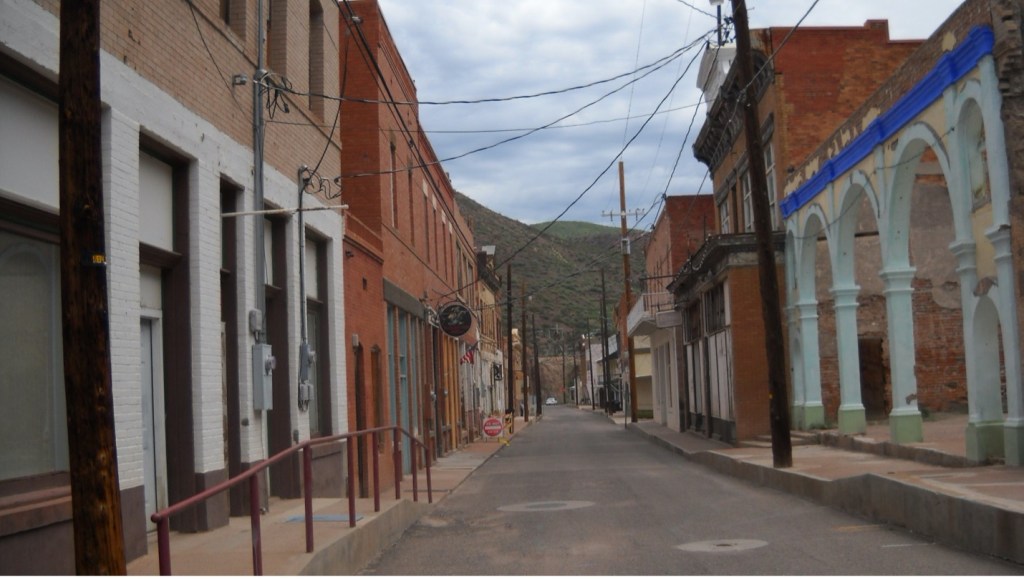
Chase Creek, Clifton, Arizona
Then the wind began, warm, incipient, full of voices from the past, the murmurs of ancient geraniums, sighs of disenchantment that preceded the most tenacious nostalgia. One Hundred Years of Solitude – Gabriel García Marquez.
Monday
I hadn’t remembered clouds casting huge shadows on the road when I was growing up in Arizona, but when my goddaughter, Jacky, and I made a trip to my childhood home in 2010, the brief respite from the summer heat that those enormous umbrellas in the sky provided seemed like necessary miracles to me. Even the geography appeared different than I remembered. It had been a year of ample rain which had turned the mountains vibrant shades of green and allowed the desert to bloom in glorious color. The desert of my youth was perpetually dry and gasping. All of this liveliness seemed antithetical to the purpose of my trip, because I had made the journey home to see my friends, most of whom now resided in cemeteries across the state. “Do you have any friends that are living?” Jacky asked. I did, and she would meet them along the way, but the purpose of the trek was to visit my ghosts. Ghosts who were not all dead, but for one reason or another, were no longer available to me in the physical form. Once our trip was over, I realized it was the towns, the roads, the voices, the places of my teenage years that still reverberated in my head, held remnants of energy, bits of my past that could no longer be touched unless I were to discover a passage back in time that existed outside of memory.
Jason Robinson: Tango

I am forever grateful to the people, land and spirits of South America, and long to return. Immersing myself in the immensity of El Sur helped me find my true size in the grand scheme of things. The steps I take now carry a knowledge of my imprint on others and guide a path for me of humility through continents eternally plagued by the dominance of and resistance to colonization. The process of colonization lives within us as colonized, and as colonizers.
Monica Tapiarene: Heimatlos

“Kommt ein Vogel geflogen….”
is my oldest recollection of childhood wonder. Oma would always sing that song to me.
Setz sich nieder auf mein‘ Fuss
Oma is diminutive for Großmutter – Grandmother, in German.
Hat ein Brieflein im Schnabel
She lived with us—my Ma, Pa, and my brothers Richard and Rubén.
von der Mutter einen Gruß.
Oma was born in Hamburg and moved to Perú in the late 1930s.
Lieber Vogel, fliege weiter,
nimm ein’ Gruß mit, einen Kuss,8
without speaking a word of Spanish
denn ich kann dich nicht begleiten,
and she never returned to Germany
weil ich hier bleiben muss.
“because I must stay here” reads the last line as an ominous harbinger.
I loved when Oma sang to me. Even though I understood every single word, I did not know back then that Oma was referring to the mother she lost when she was 16 and to “Heimatlos” the loss of her Motherland. My playful mind would fly away with that bird—Kommt ein Vogel geflogen– all the way to Oma’s birthplace. I would send a greeting with a kiss to her mother-nimmt ein Gruß mit, einen Kuss– Oma was always a foreigner in Peru. She brought Germany with her to Perú. I, too, left my homeland and shared experiences of loss like Oma. The “Deutschland” that existed only in my child’s imagination—that magical place Oma had shared with me in Perú—was different from the real country I visited as an adult.
Angel Vasquez: The Other: Color Hierarchy in the Dominican Republic

I was taught to dislike myself as black, or as one of black descendant. To be Dominican was meant to say to be as close to white skin as possible, like to be Spanish or of Spanish descendants. I learned that from my relatives, my father, and school. “Yes, our skin is black, brown, dark-skinned, light-skinned, but we are not blacks.” That was how they would speak of themselves, then and now; mostly lies to fill the air with what might keep them, us, on top as the better people, that being Dominicans. I grew up in this environment, wondering if this representation of my skin color was a truthful depiction of my race in the Dominican Republic because certainly, it was not in the USA. Only time taught me that in both sides I experienced racism, and in both I was The Other.
Christa Walker: Fight Night in Sin City
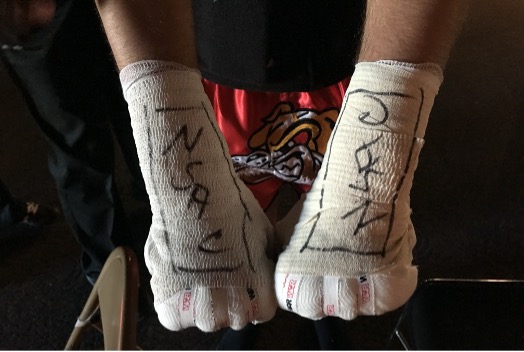
Everybody has a plan until they get punched in the mouth. —Mike Tyson
McCarran Airport is loud. This is the first thing I notice after I disembark the plane and head toward baggage claim. There are slot machines in the center, between the gates and the Starbucks, Newsstand and bars. I walk through a cloud of smoke and the dinging of the rows slot machines grows louder as I pass between, nearly colliding with a drunk couple wearing matching “Hard Rock Hotel” t-shirts. These people are tourists, like most of the people in the airport, visiting Las Vegas for the weekend. I’ve only brought my carry-on suitcase because I’m only going to be in Vegas for one night, to corner my first Muay Thai fight as a cutman (or, in my case, a cutwoman) at Buffalo Bill’s Hotel and Casino in nearby Primm, Nevada. I must say that my experience in the Box world taught me much more than wrapping fighter’s hands.
Jesus Verde: Disfrutando el presente y reviviendo el pasado

It was Semana Santa 2014. My niece Alexandra and I arrived in Mazatlán on Palm Sunday. The idea was to spend Holy week there. The last time we were there was in 2007 for a memorial we for the first anniversary of my father’s passing. Alexandra was eager to spend time at the beach and explore Mazatlán’s night life with the cousins she had met back in 2007. Since this is probably the time of year when people in Mexico travel the most within the country, I knew the city would be more crowded than usual. It didn’t matter to me though because I was going to spend most of my time in my hometown about 20 miles south.
 On The Edge
Leave a comment